

The not-so-empty nest: How to help adult kids achieve financial liftoff
When your children turn to you for financial support — and a roof over their heads — these tips can help you give them the tools they need to move forward on their own


MOST PARENTS HAVE MIXED FEELINGS about achieving empty-nest status. They miss their kids but take great pride in knowing they’ve set them on the path to financial independence. So when a major report comes out documenting a long-term increase in “boomerang kids” — young adults coming home to live with their parents — there’s cause for concern. According to a 2025 Pew Research report, 18% of adults age 25 to 34 lived with their parents in 2023 — up from 8% in 1970 — with percentages as high as 33% in parts of California, Texas and Florida.1 If they’re not living with their parents, many get help with rent or mortgage payments. According to a Bank of America Better Money Habits survey, “A Window into Gen Z’s Financial Health 2025,” 50% of Gen Z (ages 18 to 28) don’t pay for their own housing.
Clearly, for many parents, the empty nest is not so empty these days. What’s more, according to a Savings.com survey, half of parents with adult children say they provide regular financial assistance to one or more of their kids.2
Have the kids moved in?
Save a bundle by bundling
Add your adult child to your mobile family plan.
As long as they live with you, you may be able to cover their vehicle on your auto insurance policy.
See if they might qualify as a dependent on your health insurance policy.

There are many reasons for the financial pressures today’s young adults face: inflation, student debt and high mortgage rates, among them. Fortunately, for some parents, helping their kids isn’t a burden. In fact, according to the Savings.com survey, 39% of parents said doing so had not been a sacrifice to their own financial security.2 These not-so-empty-nesters are more likely to be focused on finding ways to help their kids stand on their own financially.
“Of course, you want to be there for your children when they need financial help,” says Cynthia Hutchins, director of Financial Gerontology at Bank of America. “But the most important thing you may be able to give them is a refresher course in the financial basics.” Below, she suggests some tips that can help you help your adult children manage the financial pressures they face and establish better money habits.

Lend an ear — and some budgeting advice
If your adult children are asking for help paying their bills, first ask them what’s causing the financial pressures they’re facing. “It can help to share some of the financial missteps you may have made when you were younger, as well as the financial lessons you wish you’d known back then,” says Hutchins. Let your kids see that financial mistakes can be overcome if they stick to a well-thought-out plan.
Then encourage them to create a budget that prioritizes expenses, designating some things as “needs” and others as “wants.”
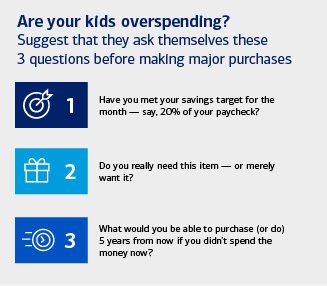
Tell them about some of the trade-offs you had to make when you were starting out. Next, schedule some time for them to talk with your financial advisor, who can offer more perspective on the value of having a financial plan and ideas on how best to get back on track to pursuing their financial goals, like saving for a mortgage down payment or going back to school.

Help out — but attach some strings
To encourage accountability, you could think about structuring your financial assistance in the form of a loan, Hutchins suggests. Put it in writing and set a mutually agreed upon schedule for repayment. While the IRS requires you to charge annual interest on loans made to family members, the minimum required rate is usually well below the interest charged by traditional lenders. IRS rules also require you to keep written documentation and a record of payments.3
If your financial support comes in the form of a large gift (the down payment on a mortgage, for instance, or help paying off a student loan), consider positioning the gift as an early inheritance and adjusting your wealth transfer plan to avoid any potential sibling resentment.
Can adult children qualify as dependents on your taxes?
It depends. IRS rules state that they must:
- Live with you for more than six months of the year
- Be under age 19 (or under age 24, if a full-time student)
- Not provide more than half of their own financial support
Source: IRS.gov, Dependents. July 8, 2025.

Set limits — on yourself and your kids
TIP: Remind the kids that they have 40 to 50+ years of earning power ahead of them — you don’t.
Before you commit to providing financial support, it’s a good idea to sit down with your advisor to assess your current liquidity and cash flow situation and discuss how you might lend a hand without losing momentum on progress toward your own goals.
When talking with your children, be candid about the level of financial support you can offer and how long it can last. Consider limiting your financial contributions to helping to cover their essential expenses (car loan, yes; cable bill, not so much) and only after they have personally covered as much of those expenses as they can. You may even want to give your adult child a deadline for moving out — a goal to work toward — and explain that your life plans (retiring, relocating, etc.) can’t be put on hold indefinitely.
Above all, emphasizes Hutchins, “Remember to pay yourself first. Never dip into money earmarked for your retirement, or you may end up being the one needing financial support when you grow older.” Remind the kids that they have 40 to 50+ years of earning power ahead of them — you don’t. They’ll understand.
Discover more with Merrill
Work one-on-one with a Merrill advisor for more insights and personalized guidance. Connect with us today.
Have us contact you
Try Merrill Advisor Match
The BullPen
Timely insights to stay ahead of the curve